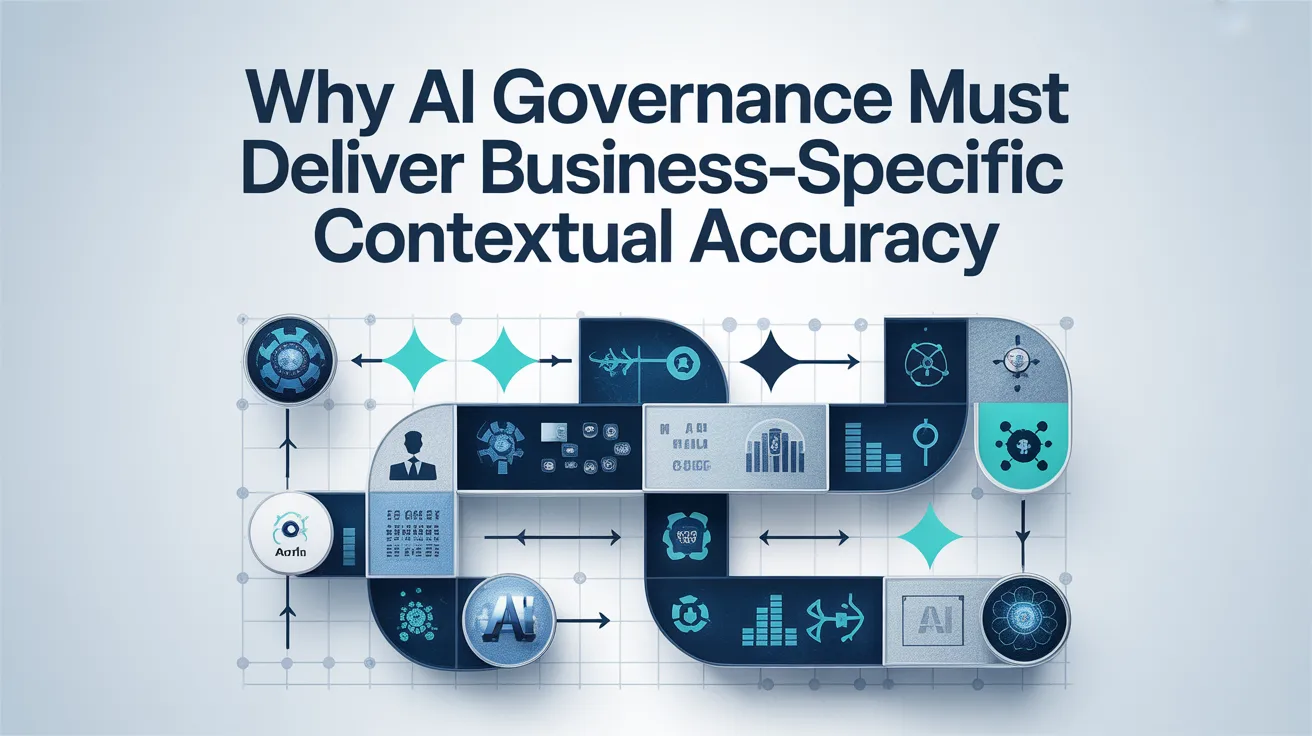
Why AI Governance Must Deliver Business-Specific Contextual Accuracy
Executives are no longer worried about whether artificial intelligence works. They are worried about whether it works correctly for their business. A model that performs well in a generic benchmark can still fail inside a regulated bank, a healthcare network, or a manufacturing plant. That gap between technical performance and operational reality is where ai governance business-specific contextual accuracy becomes mission critical.
When decision systems operate without contextual alignment, the damage is subtle at first. Risk scoring shifts slightly. Customer segmentation drifts. Automated approvals miss nuance. Over time these small errors compound into compliance exposure, financial leakage, and reputational harm. Business leaders recognize that model accuracy in isolation means little without contextual intelligence embedded in governance structures.
The market conversation has matured. Boards now ask how ai governance business-specific contextual accuracy is measured. Regulators ask how domain constraints are encoded. Audit committees ask who owns contextual validation. The answers separate experimental AI programs from enterprise-grade AI ecosystems.
Understanding AI Governance Beyond Compliance Checklists
AI governance has often been framed as a compliance exercise. Policies get drafted. Ethical principles are published. Oversight committees meet quarterly. This creates visibility but rarely guarantees that AI decisions reflect the business environment they operate within. ai governance business-specific contextual accuracy requires a different mindset.
Governance must integrate legal frameworks, operational processes, domain expertise, and technical monitoring. It must address how data is sourced, how features are engineered, how outputs are interpreted, and how feedback loops are structured. Without contextual grounding, governance becomes procedural rather than protective.
Organizations influenced by frameworks such as the OECD AI Principles or the National Institute of Standards and Technology AI Risk Management Framework often begin with strong policy foundations. Yet contextual accuracy only emerges when those frameworks are translated into industry specific controls and validation criteria.
Defining Business-Specific Contextual Accuracy in AI Systems
Contextual accuracy goes beyond predictive accuracy. It refers to the degree to which an AI system interprets inputs and produces outputs that align with the specific operational logic of a business environment. ai governance business-specific contextual accuracy demands validation at that level.
A fraud detection model inside retail banking must interpret transactions differently than a model in insurance claims processing. A hiring algorithm inside a global enterprise must reflect regional labor regulations and internal diversity commitments. Context shapes what constitutes correct behavior.
This means contextual accuracy depends on domain ontologies, regulatory mappings, exception handling rules, and dynamic feedback loops. Governance mechanisms must enforce validation of these contextual layers before deployment and continuously after release.
Why Generic Model Accuracy Fails in Regulated Industries
Regulated sectors illustrate the risk vividly. A credit decisioning model that scores well in lab testing may violate fair lending expectations once deployed. Agencies such as the European Commission have advanced regulatory approaches that emphasize explainability and risk categorization. These requirements demand contextual interpretation.
Healthcare AI provides another example. A diagnostic system trained on global data may underperform in a specific hospital network with unique patient demographics. Governance without contextual auditing misses that nuance. ai governance business-specific contextual accuracy ensures demographic representativeness is validated against local populations.
In financial markets, algorithmic trading systems influenced by supervisory standards from bodies like the U.S. Securities and Exchange Commission must reflect risk exposure thresholds and reporting obligations. Context defines acceptable variance. Governance frameworks must embed that contextual map.
The Architecture of Contextual AI Governance
Strong governance architecture links strategy, technology, and oversight. It embeds contextual validation at every stage of the AI lifecycle. ai governance business-specific contextual accuracy is not achieved through a single control but through layered accountability.
The architecture usually spans data governance, model governance, operational risk management, and executive oversight. Each layer enforces contextual constraints that reflect business logic. When these layers operate in isolation, contextual drift becomes inevitable.
Boards increasingly demand visibility into contextual metrics. They want to know not only whether a model performs but whether it aligns with strategic objectives, regulatory obligations, and ethical commitments.
Embedding Domain Expertise into Model Lifecycle Management
Technical teams often build models in isolation from business operators. This separation is a root cause of contextual misalignment. ai governance business-specific contextual accuracy requires domain experts to participate throughout the lifecycle.
Domain experts help define acceptable error rates, edge case scenarios, and contextual red flags. They identify where automation should pause for human review. They clarify what the model should never decide autonomously.
This integration shifts governance from reactive auditing to proactive design. Context becomes encoded into feature selection, threshold calibration, and exception workflows rather than patched in after deployment.
Aligning Data Governance with Operational Reality
Data reflects historical decisions. If those decisions were biased or incomplete, contextual distortion is embedded in the dataset. ai governance business-specific contextual accuracy demands that data governance evaluate representativeness against actual business conditions.
For example, a supply chain forecasting system must account for regional logistics variability. Data sourced from one geography may not generalize. Governance must verify that datasets reflect current operational realities rather than outdated patterns.
Data lineage tracking, metadata enrichment, and context tagging become central. Governance should require that each dataset includes documentation explaining its domain limitations and operational scope.
Continuous Monitoring for Context Drift
Models degrade when the business environment changes. New regulations emerge. Customer behavior shifts. Market volatility increases. ai governance business-specific contextual accuracy depends on continuous monitoring mechanisms that detect context drift.
Drift detection should examine not only statistical distribution changes but also business outcome deviations. A stable accuracy metric may hide shifts in demographic fairness or compliance exposure.
Operational dashboards must surface context specific indicators. Governance committees should review them regularly. Contextual monitoring converts governance from static documentation into dynamic risk management.
Measuring Contextual Accuracy with Practical Governance Metrics
Measurement anchors governance credibility. Without metrics, ai governance business-specific contextual accuracy becomes aspirational rhetoric. The challenge lies in defining indicators that reflect contextual alignment rather than generic performance.
Organizations that mature in this space often create cross functional scorecards. These scorecards integrate technical metrics, regulatory indicators, and operational outcomes. They quantify contextual fit.
Below is a practical example of how contextual governance metrics can be structured.
| Context Domain | Validation Metric | Data Review Frequency | Business Owner | Risk Impact Level |
|---|---|---|---|---|
| Credit Risk Modeling | Fair lending variance threshold | Monthly | Chief Risk Officer | High |
| Healthcare Diagnostics | Demographic sensitivity index | Quarterly | Medical Director | High |
| Supply Chain Forecasting | Regional forecast deviation rate | Monthly | Operations Head | Medium |
| HR Recruitment AI | Bias exposure score | Quarterly | HR Compliance Lead | High |
| Marketing Personalization | Context relevance accuracy rate | Monthly | Marketing Director | Medium |
This table illustrates that ai governance business-specific contextual accuracy translates into measurable checkpoints. Each row ties contextual validation to ownership and risk classification.
Metrics must evolve as the business evolves. Static governance indicators create blind spots. Context is dynamic and governance must adapt accordingly.
Linking Contextual Metrics to Executive Accountability
Contextual governance gains traction when executive incentives reflect it. If leadership compensation focuses only on efficiency gains, contextual safeguards may erode under pressure. ai governance business-specific contextual accuracy must influence performance evaluation.
Boards can mandate contextual risk reporting in quarterly reviews. Internal audit teams can validate contextual metrics. When executives see contextual alignment as a board level expectation, governance shifts from technical compliance to strategic priority.
Accountability strengthens when contextual failures trigger structured remediation processes. Transparency builds trust internally and externally.
Regulatory and Global Perspectives on Contextual Governance
Global regulatory momentum has intensified scrutiny of AI deployment. Frameworks under development across jurisdictions highlight risk tiering and contextual evaluation. ai governance business-specific contextual accuracy aligns naturally with these regulatory trends.
The European Commission has advanced legislation that categorizes AI systems by risk profile. High risk systems demand strict oversight and contextual documentation. Businesses operating in multiple regions must harmonize governance practices across jurisdictions.
In the United States, guidance from agencies including the National Institute of Standards and Technology encourages risk based assessment grounded in context of use. This reinforces the principle that identical models can present different risks depending on deployment setting.
Multinational corporations face an added layer of complexity. Context varies by market, culture, and regulation. ai governance business-specific contextual accuracy must be localized without fragmenting oversight standards.
Cross-Border AI Deployment Challenges
A global retailer deploying recommendation engines across continents encounters diverse privacy laws and consumer expectations. Contextual governance must map these variations. One region may restrict certain profiling techniques while another permits them.
Localization requires more than translation. It requires contextual risk modeling. Governance teams should establish regional review councils that adapt central policies to local requirements.
Harmonization prevents duplication. Central governance defines principles. Local governance applies contextual filters. This structure preserves coherence while respecting regulatory diversity.
Operationalizing AI Governance Inside the Enterprise
Governance frameworks fail when they remain theoretical. ai governance business-specific contextual accuracy demands operational integration into daily workflows.
Product teams should embed contextual review checkpoints before release gates. Risk teams should review contextual metrics during model refresh cycles. Compliance teams should validate regulatory mappings continuously.
Technology platforms can assist. Model registries should capture contextual metadata. Approval workflows should require contextual validation evidence. Automated alerts should flag deviations from approved contextual parameters.
Building a Culture of Context Awareness
Cultural alignment determines long term success. Employees must understand why contextual accuracy matters. Training programs should explain real cases where misaligned AI decisions created financial or reputational harm.
Leadership messaging must reinforce that speed cannot override contextual safeguards. Incentive structures should reward thoughtful deployment.
Organizations that internalize ai governance business-specific contextual accuracy treat it as a competitive differentiator. Trust becomes a market asset.
FAQs
What does ai governance business-specific contextual accuracy actually mean in practice?
It means that AI systems are governed in a way that ensures their decisions align with the specific business environment they operate within. Validation includes domain constraints, regulatory rules, and operational logic rather than relying only on statistical accuracy.
How is contextual accuracy different from model accuracy?
Model accuracy measures predictive performance against labeled data. Contextual accuracy measures whether those predictions are appropriate within the real business scenario including compliance and operational standards.
Why do regulators care about contextual alignment?
Regulators evaluate impact rather than algorithm design. A system that functions correctly in theory may create harm when deployed in a specific context. Governance must demonstrate contextual safeguards.
Who owns contextual governance inside a company?
Ownership is shared. Technical teams manage model integrity. Risk and compliance teams oversee regulatory alignment. Business leaders define acceptable outcomes. Clear accountability structures are critical.
Can small businesses implement contextual AI governance?
Yes. Even smaller organizations can document context of use, define acceptable thresholds, and monitor outputs. Scale changes complexity but not the principle of contextual validation.
How often should contextual accuracy be reviewed?
Review frequency depends on risk level and environmental volatility. High risk systems may require monthly review. Lower risk applications may be assessed quarterly. Continuous monitoring strengthens resilience.
Building Trust Through Contextual Precision
AI systems influence credit approvals, medical diagnoses, hiring decisions, and supply chain flows. These decisions shape lives and markets. ai governance business-specific contextual accuracy is not a theoretical ambition. It is the mechanism that protects organizations from silent systemic error.
Enterprises that invest in contextual governance build credibility with regulators, customers, and investors. They move beyond superficial policy statements toward measurable accountability. Contextual precision becomes embedded in data selection, model design, monitoring dashboards, and executive oversight.
The future of AI leadership belongs to organizations that treat governance as operational intelligence. When contextual alignment becomes a daily discipline rather than a quarterly report, AI shifts from experimental technology to trusted infrastructure. ai governance business-specific contextual accuracy stands at the center of that transformation.